

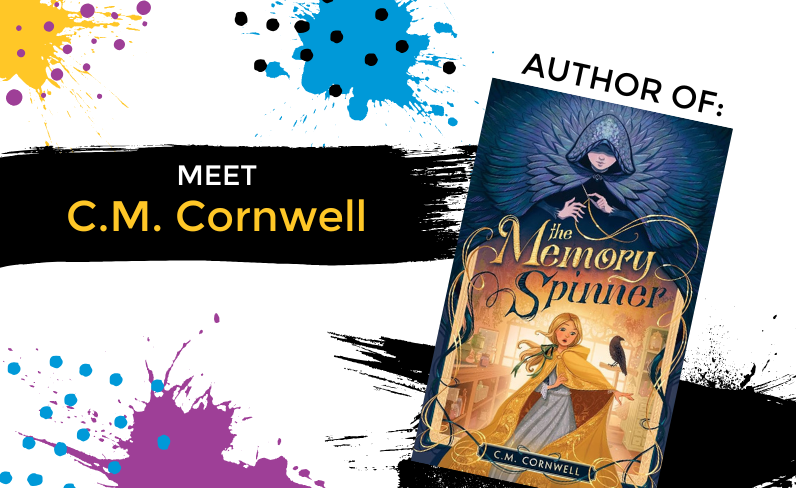
This month’s Ink Splat Author Interview features C.M Cornwell, author of The Memory Spinner.
In our interview, C.M. Cornwell shares with us about the rich fantasy world she developed for her novel, discusses how her hands-on work with crochet and the fiber arts has informed her writing, offers strategies for getting unstuck, and even gives us a sneak peek into her next project.
You can learn more about C.M. Cornwell on her elegantly designed website here: www.cmcornwell.com
Writing Challenge
Make Life Challenging for Your Character
In her interview, C.M. Cornwell talks about how she begins a novel idea. First, she develops a character who has a significant challenge. In The Memory Spinner, Lavender’s core issue is a memory problem that she develops after her mother’s death. This situation would be challenging in itself, but everything is made worse because Lavender is trying to keep her memory problems a secret from her father. Plus, she apprentices in her father’s apothecary, in an 1880’s world, and she can’t rely on modern conveniences to help her with medical remedies. She relies on her memory to do her job well. You can see how the perfect storm starts to brew up because of Lavender’s challenge, her circumstances, and her deep desire to keep it all a secret.
Try this: Think of an issue a character might have that could significantly impact their day-to-day life. Who is this character, and how might their issue have begun? How might you create circumstances that increase the difficulty of this challenge for them? Consider the people in their world, the setting, their circumstances, and any other factors that might “raise the stakes,” which is another way to say “increase the difficulty of their problem, and the importance of them overcoming it.”
Once you come up with your character and their problem, try one of our favorite Inklings games: Big, Bigger, Biggest.
STEP ONE: Imagine a scene where your character has to deal with their challenge. Mentally play this out in a way that feels truly big for them.
STEP TWO: Once you have the shape of your scene in mind, with a strong beginning, climax, and resolution, try rewinding the scene and playing it out again. How might you make this big scene even bigger? Would you change the setting? Bring another character into the situation who complicates things? Imagine how the bigger scene would play out.
STEP THREE: Then, just for fun, try one more round where you imagine the biggest situation you can picture. Remember, you’re visualizing, not writing, so there’s no risk in pushing past what seems reasonable. You never have to write the scene this way, so why not go all out?
STEP FOUR: After you play through that biggest scene in your imagination, review your options and make a choice. Which version of the scene feels best to you? Maybe you’d even want to create a hybrid of more than one of your options.
If you love what you come up with, try writing the scene out next. If you love it, consider sharing your writing with your Inklings community. Did you know that as an Inklings member, you can submit your creative writing on our Inkwell app to share with an audience of enthusiastic readers? You can ask for revision feedback on a work in progress, or submit a finished piece and hear back from readers about what they loved.
Join us and share your writing on the Inkwell!
Tell us a bit about yourself and about your debut novel, The Memory Spinner. What sparked the idea for your book or kicked off your writing process?
Hi everyone, I’m C.M. Cornwell, and I write whimsical stories with magic and heart. I’m originally from the San Francisco Bay Area, and I currently live in Pennsylvania with my family. My debut novel, The Memory Spinner, is about a young girl named Lavender, who develops a memory problem after her mother dies, so she seeks out an enchantress to help her create a magical cure. It started out as my own twist on classic fairy tales like Hansel & Gretel and Rumpelstiltskin, but it developed very much into its own story.
How do you approach making all the complex choices that it takes to build a fantasy world?
When I first get the idea for a story, it usually starts with a character who has a problem. That’s the core of the story for me. When the setting and world-building can play off that character’s problem, further challenging them, it’s a win.
For example, in The Memory Spinner, the main character, Lavender, is an apprentice to her father’s apothecary shop, and she is trying to keep her forgetfulness a secret from him. She lives in an 1800’s inspired cottagecore world with magic, which creates additional obstacles for her, since she can’t rely on modern conveniences to help her with medical remedies. She only has her memory to rely on, which of course, is incredibly faulty.
When I’m in the early stages of a story, I ask a lot of questions about what will push my characters toward the events of the story, what will challenge them and encourage them to change, and what kind of world will enhance that journey for them. When that foundation is secure, then I just have fun with world-building and make it the sort of place I want to visit. I’m going to spend a lot of time there, after all, through drafting and edits.
You used to run an Etsy shop and sell hand-crafted costumes! What has making costumes with your hands taught you that you carry over into your writing?
In the literal sense, it helped me write authentically about what crocheting and fiber arts are like for my characters! But more importantly, I think it helped me learn how capable I was, and that I could do hard things.
I think having that Etsy shop helped me build confidence through the process of trying something new, improving through effort, and then being proud of the end product. Often, I would try a new hobby, and if I didn’t do A+ quality work right away, I gave up. Crochet was one of those things that I almost stopped because it didn’t come naturally to me. But I worked hard to learn new patterns, and then I tailored them to what I liked, adding my own twist. The items were rough around the edges at first, but they improved over time. The whole experience taught me how much patience, effort, resilience, and determination goes into improvement, and how rewarding it feels to have an end product turn out like I imagined. It sounds a lot like the writing process, doesn’t it?
Were there any moments during your writing process when you felt stuck or uncertain about where to go next? What strategies helped you keep going?
Usually if I get stuck, it’s because of my mindset. I’m scared to make a mistake with my writing, and I don’t want to have to scrap hours, days, or weeks of hard work. But I’ve never written a story perfectly the first time. I doubt any writer has. It’s part of the process to have those missteps, and that’s okay. The most important step is to just get words on the page. I can always edit my stories into something I’m proud of later. So, if I’m feeling stuck, I’ll brainstorm possibilities of where to go next. Sometimes it’s a simple brainstorming session where I write ideas down in a notebook, and other times, my brainstorming takes several days. During that time, I watch movies, read other books, try other hobbies, try a change of scenery, and spend time with friends and family. When I come back to my story, I always end up landing on an idea that I’m excited to pursue next.
What’s your next project?
I’m currently working on developmental edits for my next middle grade book, a contemporary fantasy called The Paper Ballerina, which is slated for summer 2027 with Delacorte Press/Penguin Random House. It’s Toy Story meets Pinocchio, with a seaside setting, a sisterhood theme and heaps of heart.
Check out The Memory Spinner and all of our recent Ink Splat authors’ works at our Bookshop.org Store.

INKLINGS CONNECT
Looking for a leadership opportunity?
Our two Inklings leadership teams, the Youth Advisory Board and the Inklings Member Advisory Team are open now for high-school aged applicants.