
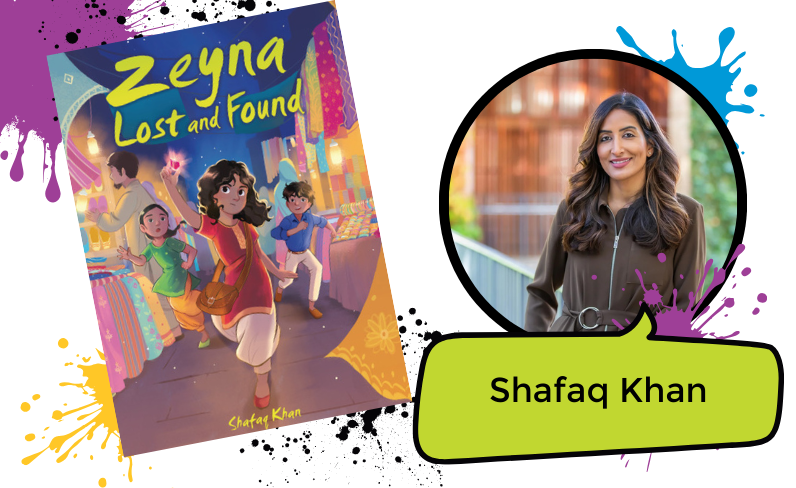
This month’s Ink Splat Author Interview features Shafaq Khan, author of Zeyna Lost and Found.
In our interview, Shafaq Khan shares with us about developing a character and finding their voice on the page, writing about belonging and identity, and she encourages us to be bold and to share the stories that only we can tell with the world.
You can learn more about Shafaq Khan and her writing here: www.shafaqkhan.com
Writing Challenge
Let Your Reading Inspire Your Writing
In her interview, Shafaq Khan shares how helpful reading can be for writers. What books are sparking your interest, curiosity, and creativity these days?
Try this: Choose a book you’ve read recently that you loved. List three to five things that you liked most about the book. Maybe it was the way the character got into impossible situations, or the hilarious dialogue. Maybe you particularly liked the settings or the overall world of the story. Maybe what stood out was how the author used words in descriptive, playful, or surprising ways.
Choose one, and think about how you might use it as inspiration for a short creative experiment. You might write a character profile, a short scene, or a poem using an idea your reading sparked.
Once you’re written your brief piece, consider sharing your writing with your Inklings community. Did you know that as an Inklings member, you can submit your creative writing on our Inkwell app to share with an audience of enthusiastic readers? You can ask for revision feedback on a work in progress, or submit a finished piece and hear back from readers about what they loved. Some of the most fun pieces on the Inkwell are experimental, ideas that spark innovative possibilities for other Inklings, like this one by MagentaPencil.
Join us and share your writing on the Inkwell!
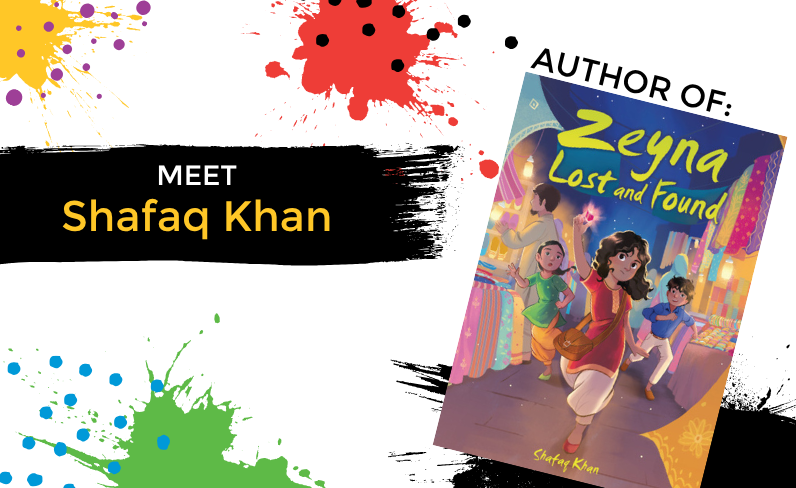
Q: Could you tell us a little about yourself and your journey to becoming an author? What first drew you to storytelling, and what eventually led you to write Zeyna Lost and Found?
A: I loved books and so naturally, writing one was on my bucket list. I’m also a lawyer and spent the earlier part of my career as a direct services attorney, representing clients on the verge of eviction in housing court. The experience of telling stories continued throughout that part of my life and I had a chance to hone the skills of effective storytelling – I started to focus and understand which details and framing resonated with my audience.
I specifically wanted to write a story with a protagonist that was familiar to my own life experience and background, but on an adventure that felt out of this world. Zeyna Lost and Found is a fun escape but also one that expresses my perspective on everything from sibling relationships, collective power, Urdu, trifle and everything in between. Setting this book in 1970 allowed me to explore a different time and of course, Zeyna’s journey on the Hippie Trail was the perfect opportunity to give a glimpse of a part of the world that many readers may not be as familiar with.
Q: Your book is set in 1970s London and follows a British-Pakistani girl navigating identity, imagination, and belonging. What sparked the idea for Zeyna and her story?
A: As soon as I delved into the research of the British-Pakistani experience, the immigration patterns, and the struggles with assimilation, I knew that Zeyna was going to be navigating what it meant to belong. I also knew, firsthand, that if you grow up outside of the country that you are ethnically from, that you may struggle to understand how you fit in. For example, Zeyna’s cousins in Pakistan make fun of her Urdu accent. Despite that, she continues to try to understand what it means to be British and also Pakistani. And so, here was an opportunity to talk about the feeling that many kids feel: the desire to fit in and belong and a lesson that everyone deserves to belong.
Q: Zeyna is curious, observant, and always looking for meaning even when others don’t see it. What do you hope readers might learn or feel through her perspective?
A: These characteristics set Zeyna apart from other people because it allows her to develop an understanding of the world. Even when she forms an opinion, she is open to information that could change that opinion. It’s a critical part of how she explores new places when she travels the Hippie Trail, her relationships with her cousin and brother, and even her interactions with her nemesis.
Q: How did you find Zeyna’s voice on the page? Did it come easily, or did it evolve as you wrote?
A: Zeyna’s voice evolved quite a bit. While I knew that I wanted her to be someone who was always making jokes, whether they landed or not, she also started off knowing a lot more than the Zeyna you will read now. I realized I didn’t want her to have all the answers and that opened up the possibility of a flawed protagonist who needed to rely on others for information and answers, and who would a lot of mistakes along the way.
Q: When you feel stuck or unsure where a story should go next, what helps you move forward?
A: When I feel stuck or unsure about where a story should go next I tend to go back to reading books in the same genre/category. That helps me improve my craft and it can be a source of inspiration for how to proceed. I also sometimes start a short writing project to reassure myself that I have not lost my ability to write (lol). Other times, I take a break and let myself step away. Sometimes that time away gives me a fresh perspective and renewed energy to continue to push through.
Q: Revision can be one of the hardest parts of writing. What does your revision process look like, and how do you know when a piece is getting closer to what you want it to be?
A: I start on a macro level before getting down to line edits. That means, I start reading the story in larger chunks to ensure that the plot makes sense and that the character arcs are rational and compelling. Then I break down my edits further to sections, chapters, and finally, line edits. I recall a massive edit that I had to do for Zeyna that felt very overwhelming and I stepped away for a few months. When I came back to the manuscript, I ended up re-outlining the story and that helped me understand what I was working with, what I could take out, what did and didn’t make sense. It was an excruciating exercise but worth the time and energy.
Q: Are there any simple revision strategies you use, approaches our writers might try when they want to make their work clearer, stronger, or more vibrant?
A: A simple, albeit obvious, revision strategy is to start with what feels easy and work scene by scene from there. If you think that there is a part of the story that will be an easy fix, then starting with that helps you build momentum and so much of writing is pushing through the overwhelm. Another strategy I have used for a big edit or revision is just physically taking it out of the document that you are working in so you can edit it in smaller parts. It helps make it feel manageable.
Q: Your book explores belonging and identity in a heartfelt way. How has your own experience as a third-culture kid shaped your storytelling?
A: I will always feel like an outsider because I was born into it. That discomfort is my baseline. I knew that I wasn’t from Saudi Arabia, and I loved the language of Pakistan (Urdu), and my NYC experience crystallized my goals and outlook. All of these things can be true at once and they make up my truth. It has helped me with my storytelling because I view stories as far more multi-dimensional and layered and I assume that I have lots to learn about anyone that I meet. The same is true about my characters.
Q: If you could give one piece of advice to youth writers (or to your younger writer-self), what would it be?
A: When you are unsure about what to write, then read. When you do start writing, it is helpful to outline, but then just start writing. It’s important to have something to work with, even if it’s imperfect. Writing is like sculpting a piece of clay. You need to start somewhere and then your editing will help sculpt it into a beautiful sculpture that everyone will marvel at (hopefully!). Getting your story on paper is the first step and then you can go back to edit it as many times as you want, with the help of others. It will be painstaking and exhausting but stay the course, because at the end of it you will have a story to share with the world.
Check out Zeyna Lost and Found and all of our recent Ink Splat authors’ works at our Bookshop.org Store.