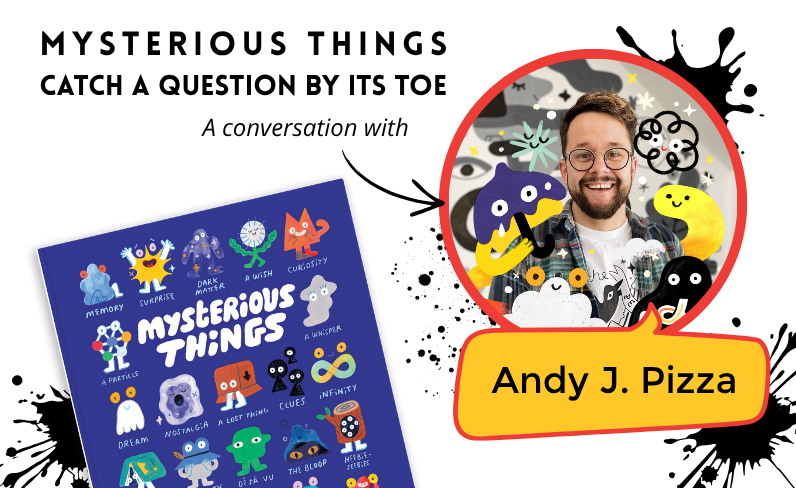
This month’s Ink Splat Author Interview features Andy J. Pizza.
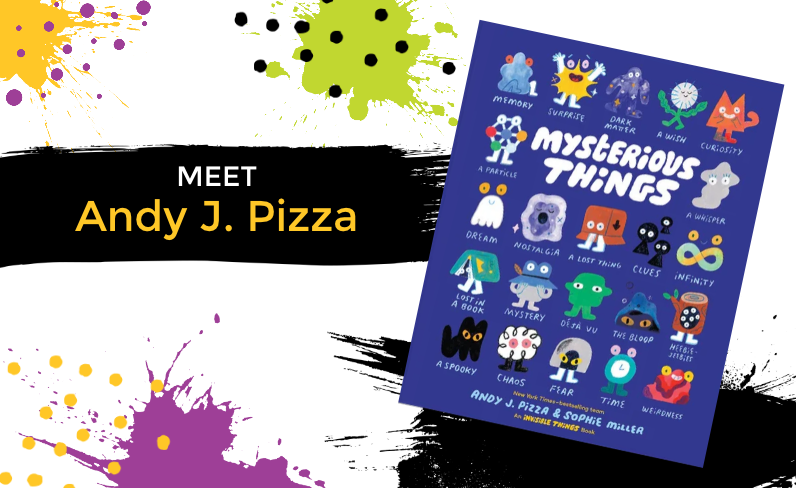
Andy J. Pizza is an illustrator, author, speaker, and host of the Creative Pep Talk podcast. His picture books include Invisible Things and Mysterious Things. He joined us for an interview this month, and shared some thoughts on curiosity, inspiration, and how story can help us all see the world in fresh and intriguing ways.
You can learn more about Andy J. Pizza and his writing here: www.andyjpizza.com
Writing Challenge
What Would You Do Differently?
In his interview, Andy J. Pizza shares how we can see and hear our own voices more clearly by paying attention when we read or watch something and think: I’d do that a little differently.
Try this: Choose a book or a movie you’ve recently experienced. Maybe you loved some parts of the story, but others would fit your taste even better if you handled them differently. How could you use someone else’s work as a springboard for your own idea?
First, boil the story down to its core recipe. If you had to describe it in a sentence or two, how would you describe what happens? Take that core and transform it into a story that’s entirely your own. You’ll likely need to add a lot, and change many details to make it truly your own. And importantly, make sure to change the things that you wished were done differently in the original.
Storyboard or write a brief overview of your story concept. Notice what you see in your own work now. What “moves” did you make to make this piece your own? Some of those moves may be part of your distinctive voice. Whether you take this story further or not, make note of the qualities you notice about your voice. This is pure gold. How might you carry that insight into future work?
Consider sharing your writing with your Inklings community! Did you know that as an Inklings member, you can share your writing and thoughts on the writing process on our Inkwell app? An audience of enthusiastic readers is waiting to hear from you!
Join us and share your writing on the Inkwell.
Q: Could you tell us a little about yourself and your creative journey? What led you from illustration into storytelling and children’s books?
A: I started my illustration career in 2008 and have worked with clients including Xbox, Target, and Warby Parker. I’ve also made the Creative Pep Talk podcast for more than ten years and 500 episodes. These days, children’s books are my main creative focus. I first wanted to make picture books because I loved them, but also because clients kept asking me to make my illustration work look more adult. I eventually realized the honest answer was that I didn’t want to. I wanted to make work with the energy and playfulness that already felt natural to me. My route into storytelling was roundabout, through mythology and the hero’s journey, but it helped me see how pictures, symbols, and stories could work together.
Q: Stories often begin with a question. How do you find the question or idea that is pulling you toward the right story?
A: I think stories can begin with a question you want to work out as you write, or with something you want to say. My work usually starts with something I want to say, and I tease it out by asking myself questions. One of the most useful is: What are you most angry about with yourself? Anger is often a secondary emotion. It is like steam escaping from a teapot: something has built up until it cannot stay put anymore. That makes anger a clue to something you care deeply about. A lot of my books come from my frustration with my own difficulty being present. My instinct is often to escape into imagination and fantasy. The question underneath books like Invisible Things and Mysterious Things is: How can I show myself and other people what is interesting about the present moment? The richness we are looking for may already be here if we look past the surface.
Q: Your work makes invisible ideas feel concrete through characters, metaphors, and symbols. How do you discover the right image for an idea?
A: Metaphor became a life skill for me. Growing up neurodivergent in a neurotypical world, I often could not explain why something was difficult for me when it seemed easy to other people. An analogy could create understanding where a literal explanation could not. That is part of why I am so interested in illustration as a way to bring an idea to life. One example is Nostalgia. I was thinking about gratitude and realized that I can often unlock gratitude by asking, ‘What am I going to be nostalgic about today?’ Nostalgia began to feel like the ghost of gratitude: gratitude that used to be here, or could have been here. Gratitude was already a sunlike character, so I asked, ‘What is the ghost of a sun?’ A black hole. That chain of relationships led to the character. Other times an image is much simpler. A wish might be a dandelion you blow on. The test is that the symbol feels true to the idea.
Q: Many young writers think in words first and may not feel confident drawing. How can they use visual thinking to strengthen a story?
A: You do not have to be a professional illustrator. Start by saying what your story is about in as many ways as you can. I use little spider diagrams and free-associate until I begin reaching for image words, metaphors, or analogies. You can also talk the idea through with someone and ask them to notice when you use visual language. If you keep explaining, your brain will often reach for an image that makes the idea understandable. Another method is to imagine the story as a movie. Ask what the climactic scene would be, or what scene would make you feel the emotion at the center of the project. That question helped us find the emotional arc of Invisible Things. Dreams are proof that many of us can create setting, character, conflict, and images in our sleep. Even if you cannot draw what you see, you can use the scene in your head to discover what the story needs.
Q: If Story itself were one of your invisible or mysterious things, what would its superpower be?
A: I definitely think Story is an invisible thing, and its superpower is that it is who we are. I mean that literally. Consciousness is a story our neurons are telling: ‘I’m Andy. I make illustrations.’ It gives us the feeling of being ourselves and moving through life as a person. Story can also let you become somebody else for an hour. Through a book, movie, or video game, you can experience another perspective and learn something the hard way without actually being hurt. That can increase our empathy. Story is at the core of how we understand life and make meaning from it. I sometimes hear people ask how stories can become more like real life, but I am more interested in asking how we can make our lives more like stories. The more we move away from story, the less life makes sense to us.
Q: Is there anything you would tell the earlier version of yourself who had not yet made Invisible Things and Mysterious Things?
A: I would tell myself to follow my curiosity. Something will really pique my curiosity, and then I will discount it, ignore it, or forget about it for years. Later it comes back and I wonder how I lost track of it. I think about the way people walk dogs. We may think the point is to get our steps in, but the dog is there to sniff. Dogs experience the world through their noses, so the sniffing is the walk. Writing is like that. It is not about getting efficiently from page one to the final page. Writing is sniffing. It is following a tangent, noticing what becomes interesting, and letting curiosity lead you somewhere you did not plan to go. When I free-write for the podcast, the best material often appears when I let myself take every tangent until something comes alive.
Q: What helps when imposter syndrome makes you wonder whether you can pull off a creative project?
A: I face imposter syndrome all the time. One thing I notice is that I feel most alive when I am connected to curiosity and most scared when I am not. So I ask, ‘Can I get curious about what I can make happen here?’ It also helps to bring something into the project that I already know how to do and that feels like me. Art is not about proving that you are clever or better than other people. It is about connecting with another person, and that connection comes through vulnerability. The gift is saying, ‘This is how I see it.’ There is still risk in that. Someone may not like what you add. But adding the humor, emotion, perspective, or kind of character you love can turn a project that feels foreign into something you can enter with confidence.
Q: How do you balance reading, watching, learning, and getting inspired with finding your own voice and sitting with your own creative dilemmas?
A: I think of influence through the lens of the hero’s journey. You begin at home, leave your comfort zone, encounter something unfamiliar, and bring what you learned back home. I try to make a discipline of listening to new music and experiencing new stories and movies, including work that does not immediately appeal to me. Something changes in you, and you can bring that discovery back to the things that already feel authentic. A varied creative diet also keeps consumption from becoming passive. Challenging work often becomes a springboard that makes me want to create. Even dislike can be useful. You may read a book or watch a movie and think, ‘I would do that differently.’ Critique can become a creative impulse when your response is to make the story only you would make. The goal is not to avoid influence. It is to travel beyond your familiar influences and return with something that expands your own voice.
Q: When you are both writing and illustrating, how do you decide what belongs in the words and what belongs in the pictures?
A: A lot of that is intuitive, but the further I go in writing, the more I want to show and the less I want to tell. I love stories that work as allegories: the story is about one thing on the surface, while the characters, places, and actions point toward something in life. If the meaning only arrives in a long speech at the climax, the story probably has not made us feel it yet. Ideally, one clear line can fall like a domino and make everything we have already seen click into place. Illustration gives you another way to show. A character’s expression, a small action in the background, or a visual story that runs alongside the text can carry emotion without explanation. When I draw a face, I often make the same face myself because I am acting the feeling. Whether I use words or pictures, I am asking the same question: How can I help the reader feel what this means?
You can learn more about Andy and his books on his Substack at andyjpizza.substack.com.
Check out Mysterious Things and all of our recent Ink Splat authors’ works at our Bookshop.org Store.
INKLINGS CONNECT
You Love to Write. Now What?
If you are feeling like you want to get published, make your writing stronger, or have dreams about where your creativity might take you, but you are not sure where to start, let us help!